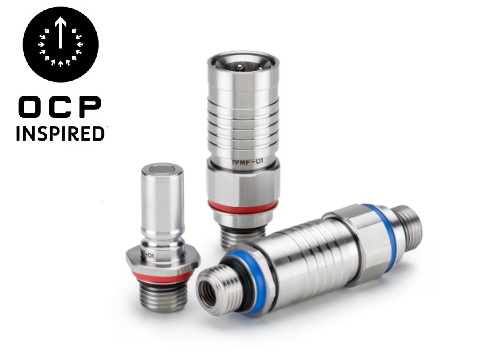
NSP1 Series Quick Disconnect Couplings for Data Center Liquid Cooling
The NSP1 Series Quick Disconnect (QD) Couplings are a critical component of modern
data center liquid cooling systems, engineered for optimal fluid flow to reduce pressure drop
and maximize overall system efficiency. Designed, tested, and validated in collaboration with hyperscale
customers, NSP1 couplings deliver reliable, high-performance, leak-resistant connections
across servers, rackable systems, and supercomputers.
Manufactured from high-quality stainless steel, NSP1 QDs are available in a wide variety of
port configurations including male thread, female thread, hosebarb, and pushlok hosebarb, making them
compatible with rack manifolds, flexible hoses, and diverse IT cooling architectures. Each coupling is assembled
and tested in a clean room environment to minimize contamination, with final assemblies verified via
helium-leak testing to ensure robust performance and trusted quality.
Key Features & Benefits
- Flush-face valve design prevents fluid loss and protects sensitive electronics
- Reduced pressure drop for superior energy efficiency and system performance
- End-of-line helium leak testing ensures quality and reliability
- Clean room assembly reduces contamination risks
- Red and blue color coding options for easy identification
- Approved for OCP Project Deschutes CDU applications
Applications & Markets
- Information Technology and Electronics
- Data Centers and Server Farms
- High-Performance Computing and Supercomputers
- Rackable Server Systems and Liquid Cooling Loops
- Industrial and Mission-Critical IT Cooling Solutions
Technical Specifications
- Size: 1/4 inch
- Material: Stainless Steel
- Port Ends: Male Thread, Female Thread, Hosebarb, Pushlok Hosebarb
- Seal Material: EPDM
The NSP1 Series combines OCP-approved design, high-quality materials, and precision manufacturing
to deliver dependable, leak-free quick disconnect couplings that enhance efficiency, reliability, and ease of
maintenance for today’s advanced liquid-cooled IT infrastructures.